When I first started working as a WPC door machine supplier back in 2012, I quickly learned that the biggest question potential clients would ask isn’t about machine size or output capacity—it’s about how the whole system actually talks to each other. If you’re in the wood plastic composite (WPC) door manufacturing space, you’ve probably faced this too: you hear about “communication protocols” all the time, but most explanations are either too technical for plant managers or too vague to make sense for someone just setting up their production line. Today, I want to break down what the communication protocol for a WPC door machine really is, how it works in our line of equipment, and why getting it right is the difference between a smooth production shift and a day of troubleshooting that eats into your profits. WPC Door Machine

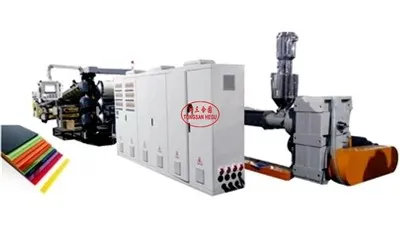
First, let’s ground this in what a WPC door machine actually does. A complete line isn’t just one big machine—it’s a series of connected units: the raw material feeder that mixes wood flour, plastic resin, and additives, the extruder that melts and shapes the WPC compound, the calibration table that gives the door profile its exact dimensions, the cutting saw that trims it to size, the embossing unit that adds texture, and the control cabinet that ties everything together. Each of these units has its own motors, sensors, and control boards, and none of them can work in sync without a way to share data. That shared set of rules for sending and receiving that data? That’s the communication protocol.
Let me explain this with an example from a client I worked with last year. A small door manufacturer in Ohio reached out to me because their old WPC line kept having issues: when the extruder speed changed, the feeder wouldn’t adjust accordingly, so they ended up with either too little compound (thin spots in the door) or too much (wasted material). The problem turned out they were using an outdated protocol that only sent data once every few seconds, so by the time the feeder got the signal, the extruder was already off by a full meter of production. We swapped out their control system and implemented a modern protocol, and that issue was gone within an hour. That’s when it clicked for me: protocols aren’t just tech jargon—they’re directly tied to your bottom line.
Now, what specific protocols do we use for our WPC door machines? Over the years, we’ve tested several and settled on two main standards that work best for our equipment, and we design every line to support both so clients can choose what fits their existing setup. The first is Modbus RTU, which is the workhorse for industrial equipment like ours. Modbus RTU is a serial communication protocol that uses RS-485 hardware, which is durable enough for factory floors with dust, noise, and temperature swings—exactly the environment where WPC door lines operate. Here’s how it works for our line: the main control PLC (programmable logic controller) acts as the “master” device, and every individual unit (feeder, extruder, calibration table, etc.) is a “slave.” The master sends a request to a slave, like “what’s your current motor speed?” or “adjust your temperature setpoint to 180°C,” and the slave sends back a response in milliseconds. For WPC doors, this is critical because the extrusion temperature can’t vary more than 2-3°C—too much and the compound will crack when shaped, too little and it won’t adhere to the texture layer. Modbus RTU handles that consistency perfectly for mid-sized lines, which is what most small to medium door manufacturers run.
The second protocol we implement on our newer, high-capacity lines is PROFINET IO. This is an Ethernet-based protocol that’s faster than Modbus RTU, with data transmission times under 10 milliseconds—ideal for large-scale production plants running multiple shifts. I had a client in Texas that makes 10,000 WPC doors a month; when they upgraded their line last year, they needed a protocol that could sync up to 12 separate units at once without lag. PROFINET IO lets us set up a central HMI (human-machine interface) where an operator can adjust settings for every unit in real time, and all data is logged automatically. For example, if the cutting saw needs to trim a door to 2100mm instead of the standard 2000mm, the HMI sends that signal to the saw via PROFINET, and the calibration table adjusts the feed rate so the door is moving at the exact speed needed to get the cut right. This reduces scrap rate by almost 15% for these larger operations, which is a huge savings when you’re producing tens of thousands of doors a month.
Now, I know a lot of people reading this might be wondering: do I really need to know the specifics of the protocol, or can I just let the supplier handle it? Here’s the truth—while a good supplier should handle designing the protocol for your line, understanding the basics will help you make better decisions when it’s time to buy or upgrade. For example, if you already have a factory automation system that uses Modbus RTU, pairing it with a WPC door machine that also uses Modbus means you don’t have to buy new controllers or retrain your operators as much. If you’re expanding to a larger plant in the next two years, investing in a line with PROFINET now saves you from having to rework the entire system later when your production volume outgrows Modbus.
I also want to talk about common mistakes I see clients make when it comes to WPC door machine protocols. The biggest one is going for the cheapest line that uses an outdated, proprietary protocol. A few years back, a new supplier in Southeast Asia was selling WPC lines at half our price, and a client of mine bought one. Within six months, they were stuck: the supplier went out of business, and there was no way to replace the control board because the protocol was proprietary—no other manufacturer made compatible parts. They had to replace the entire control system for $12,000, which wiped out all the savings from the cheap machine. That’s why we only use open, standard protocols (Modbus RTU and PROFINET) for all our lines—any third-party part or technician can work with them, which means less downtime and lower long-term costs.
Another mistake is not accounting for the communication needs of auxiliary equipment. WPC door production isn’t just the main line—you might have a mixing unit that’s separate, a packaging machine at the end, or a quality inspection camera that checks for surface defects. A good protocol should support connecting these auxiliary units too, so all your production data is in one place. For example, if the inspection camera spots a door with a texture defect, the protocol sends a signal to the cutting saw to mark that door as scrap, so operators don’t have to stop and check every single one. That level of integration is only possible if the protocol is designed to work with multiple devices, not just the main line.
Let’s get a little more technical (but not too much) about how the protocol interacts with WPC-specific functions. One of the unique parts of WPC door production is that the material properties change based on the mix: different wood flour ratios, different plastic resins, even different additives (like UV stabilizers for outdoor doors) all require adjustments to temperature, pressure, and speed. The protocol lets the control system store different recipe settings for each mix, so an operator can just select “outdoor front door, 70% wood flour” and the line automatically adjusts all units. Without a reliable protocol, the control system can’t pull those recipes correctly, leading to off-spec doors. I’ve seen lines where an operator had to manually adjust 8 different settings every time they switched mixes—taking 20 minutes per change, compared to 2 minutes with a protocol that syncs all settings instantly.
I also want to address a question I get a lot: what about safety protocols? WPC door machines have moving parts (the extruder screw, the cutting saw, the conveyor belts) that can be dangerous if not monitored. The safety protocol we integrate works alongside the main communication protocol, so if a safety door on the extruder is opened, the master control gets the signal immediately and slows the line down before anyone is at risk. This is mandatory for most industry safety standards, but not all suppliers build this into their protocol. For us, safety is non-negotiable, so the safety communication layer is part of the protocol design from day one.
Now, let’s talk about real-world results from using the right protocol. Last quarter, we delivered a line to a door manufacturer in Michigan that was switching from solid wood to WPC doors. They were worried about the learning curve, so we worked with their team to program the Modbus RTU protocol to match the settings they were already using for their old manual line. Within the first week, their operators were running the line at full speed with zero issues. Two months later, they told us that their production output was up 22%, and scrap rate was down 10%—all because the protocol made the line consistent and easy to operate. For that client, the protocol wasn’t just a technical detail—it was the foundation of their new product line’s success.
As a WPC door machine supplier, I’ve learned that the best way to help clients is to demystify the tech behind the equipment they’re investing in. You don’t need to be an electrical engineer to understand that a good communication protocol keeps your line in sync, reduces downtime, lowers scrap, and gives you flexibility to expand or upgrade later. The right protocol turns a collection of individual machines into a cohesive, efficient production system—exactly what you need to compete in the door manufacturing industry right now.
If you’re in the market for a WPC door machine, or you’re looking to upgrade your current line, don’t just focus on price or output alone. Ask about the communication protocol: what standard is it using? Is it open, so you can get parts or service from any provider? Can it sync with your existing equipment? These are the questions that will save you money and frustration in the long run. We’ve designed all our WPC door lines with both Modbus RTU and PROFINET IO support, so we can work with your specific needs, whether you’re a small shop just starting out or a large plant scaling to meet growing demand. Our team has decades of experience with WPC door production, so we can walk you through every part of the line, including the protocol, to make sure you get exactly what you need. If you’d like to talk more about your production goals, the right line for your facility, or how our protocol design can help you run smoother, more efficient shifts, we’re here to help. Reach out to our team to start a conversation that will set your WPC door manufacturing up for success.
Corrugated Pipe Machine References
Modbus Organization. "Modbus RTU Protocol Specification." Retrieved from official Modbus documentation
Siemens AG. "PROFINET IO for Industrial Automation: Technical Overview." Industrial Technology Division, 2022
American Wood Protection Association. "WPC Manufacturing Standards and Control Requirements." AWPA Annual Report, 2021
Qingdao Tongsanhegu Plastic Machinery Manufacturing Co., Ltd.
With abundant experience, we are one of the most reliable wpc door machine manufacturers and suppliers in China. We warmly welcome you to buy durable wpc door machine for sale here from our factory. Quality products and reasonable price are available.
Address: West of Xixinzhi Village, Sanlihe District Jiaozhou, Qingdao City, Shandong Province, China
E-mail: info@tongsanhegu.com
WebSite: https://www.tongsanhegumachine.com/
